
Checking for a Warrant in Chokio
No city office posts a Chokio warrant list. The route that works is the county one, worked in order and confirmed by phone. Before you call anyone, find the citation, the summons, or the court file number.
- Read the document and note the court and file or citation number it names.
- Search the county criminal, traffic, and petty case record by case, defendant, citation, or attorney.
- Add the 75 prefix when the search asks for a local court file number.
- Open the register of actions and read the hearing, warrant, recall, and service entries.
- Call the Sheriff's Office to ask whether the process is active, served, or inactive.
Chokio Fire Dispatch Is Not a Police Warrant Desk
The Stevens County Communications Center lists Chokio among the fire and emergency responders it dispatches. Law-enforcement dispatch, on the same page, covers the Sheriff and the University of Minnesota Morris police. Two different functions share one building. A reader who spots Chokio in that dispatch list may assume a city police department exists and hunt for a counter that is not there. Chokio has no police department, no municipal court clerk, and no warrant line of its own. Start with the county numbers instead, and ask the dispatcher which agency holds the file.
Chokio Police and Municipal Court
Chokio has no city police department and no municipal court. Citations and ordinance matters from Chokio are filed in the state district court, and the county handles law-enforcement service. Two offices cover it all.
Stevens County District Court
400 Colorado Avenue
Morris, MN 56267
320-349-7010
Stevens County Sheriff's Office
400 Colorado Avenue, Suite 401
Morris, MN 56267
320-208-6500
The municipal warrant page explains why the county runs no separate Chokio city court network.
What to Ask When the Citation Names a Court
A citation might name Stevens County District Court, or a court in a neighboring county if the stop happened elsewhere. Read that line first. The clerk who can help is the clerk of the court that issued the paper. With the court name and the citation number in hand, you can ask three questions in one call: which case does this citation belong to, has a warrant been issued, and what does the court need next, whether a payment, an appearance, or a new date. If a Chokio warrant turns out to be open, ask whether the court can recall it, whether a hearing must be set, and whether bond applies. Write down the name of the person who answered and the date.
Chokio Warrant Types
A Chokio matter becomes a county court file. The court labels the process by what triggered it. The types below are the ones a Chokio reader is most likely to meet.
| Warrant Type | How It Arises | Who Issues It |
|---|---|---|
| Failure-to-appear warrant | A missed appearance on a Chokio citation or case | The court holding the file |
| Bench warrant | An order issued from the bench after noncompliance | District Court judge |
| Arrest warrant | A complaint or affidavit with probable cause | Judge or magistrate |
| Release-condition warrant | A breach of terms set at an earlier hearing | District Court judge |
| Search warrant | Evidence sought in a defined place or vehicle | Judge or magistrate |
Three Chokio Warrant Checks Compared
Three tools come up in every conversation about a Chokio case. Each answers a different question, so treat them as separate checks rather than substitutes.
| Check | What It Shows | What It Cannot Do |
|---|---|---|
| Court case search | Filed cases, hearing entries, and docket events | Identify every active warrant in the state |
| Citation payment portal | Whether a payable citation exists and what is owed | Prove that a warrant was recalled |
| Sheriff status call | Whether process is active in the law-enforcement system | Change the court's file or set a new date |
Used together, the three give a Chokio reader a workable picture. Used alone, any one of them can mislead.
Inside a Chokio Warrant Record
One file format covers criminal, traffic, and petty matters countywide, so a Chokio warrant record looks like every other district file. Read these fields first.
| Court File Number | A local file starts with the 75 prefix. |
|---|---|
| Process Type | Arrest, failure-to-appear, release-condition, probation, or search. |
| Missed Date | The hearing or payment date that was not met. |
| Issuing Judicial Officer | The judge or magistrate who signed the process. |
| Service Entry | Whether an officer reported service, recall, or inactivation. |
| Next Setting | The next court date or a note to contact the clerk. |
Why No Chokio Warrant Count Can Be Quoted
Chokio publishes no warrant total, clearance figure, amnesty week, or municipal court calendar. The county posts no warrant roster either. Its board agendas say warrant register, but that phrase covers a financial disbursement list, not arrests. So any specific number about Chokio warrants comes from somewhere other than an official source. Treat it with suspicion. Check the court file instead. Note: a missing count is not a missing problem, and a missing list is not a clearance.
How Chokio Warrants Fit the County System
Warrant flow: Chokio citation or complaint › Stevens County District Court file › Sheriff service › statewide criminal justice network
A Chokio matter moves through the same county channel as every other city here, and the statewide network is the layer that lets officers beyond the county see an active warrant. The courthouse in Morris handles court and law-enforcement functions for Chokio, so the local map matters more than the city line. Find the public hours, calendar, and court contacts on the state judicial branch's Stevens County courthouse page.
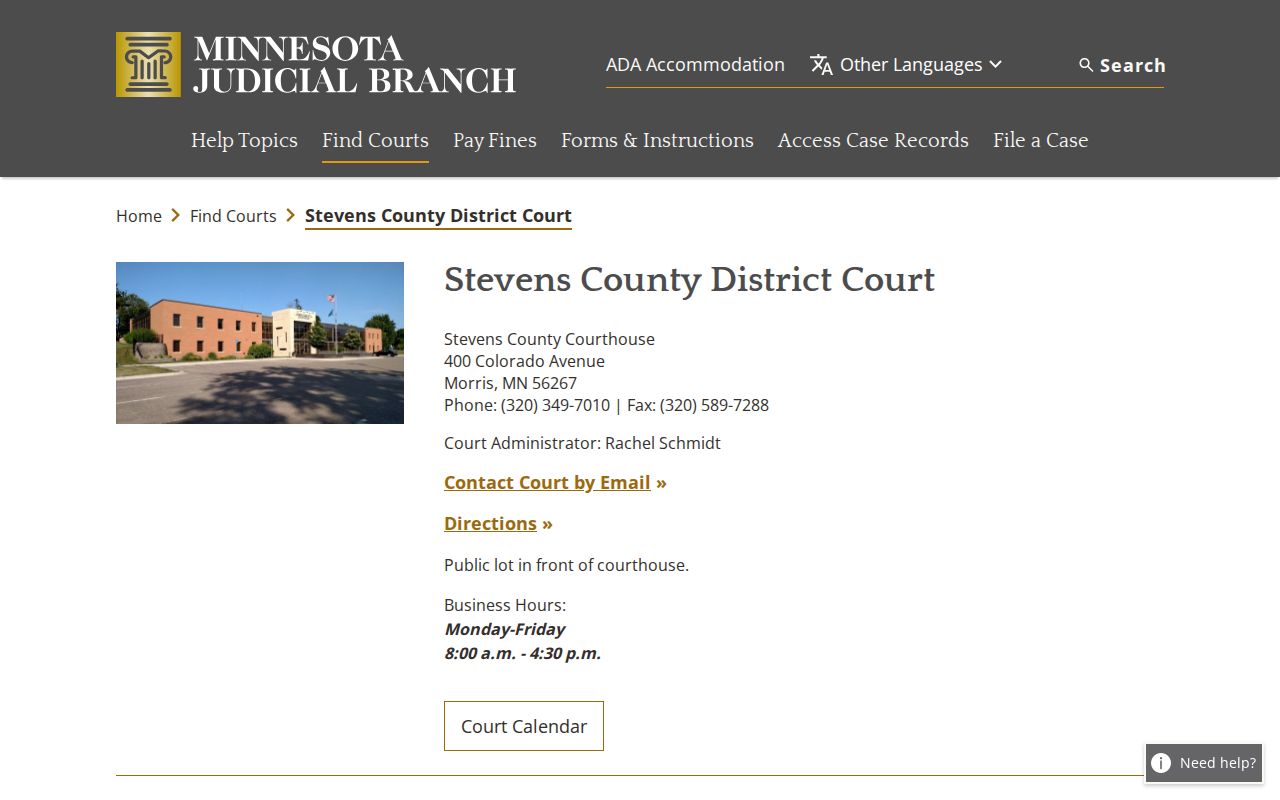
That official page is where a Chokio reader usually ends up starting. For the court, Sheriff, and state layers together, the county warrant records overview puts them in one place.
Chokio's 405 Residents and the Court Map
Chokio is the third largest of the county's five incorporated cities, with 405 residents in the 2020 Census. A city that size staffs no police department, no court, and no records desk. It is not expected to. What it has instead is a shared county system that treats every resident the same way. The practical effect is simple. A Chokio reader makes the same two calls a Morris reader makes, in the same order, with the same 75 file prefix. Note: a small city shares a county courthouse and still has its own citations and court dates.
Chokio Warrant Records and Public Access
Minnesota treats government data as public unless a law says otherwise. Court records sit under a different access rule, so neither one hands a Chokio reader every active warrant.
Key Rules:
Minnesota Government Data Practices Act - data is presumed public, and a denial must cite a legal basis.
Minn. Stat. 13.82, subd. 19 - arrest warrant index data stays confidential until custody, service, or appearance.
Rule 4 of the Rules of Public Access - court records are open subject to statutory and court-ordered limits.
No Capias Vocabulary in Chokio Warrant Files
The word capias shows up nowhere in the county's court pages or state forms. Chokio files run on plainer words: failure to appear, bench warrant, release condition, citation. Say capias to the clerk and you may get a pause. The clerk has to translate the question first. Use the local terms instead and you reach the right file fast. Ask the court directly whether a bench warrant or a failure-to-appear warrant is out on the case. Then ask if a new court date can be set. A Chokio warrant check goes quickest in the words the court itself uses.